Building for AI Is Not Adding AI

It Is Rewiring Your Entire Product Architecture
Most products today claim to be "AI-powered".
In reality, most of them have:
- A normal product
- One API call to a model
- A prompt glued on top
That is not an AI product. That is a feature bolted onto an old system.
If you are a product builder, this distinction matters more than any model choice.
Because AI does not fit into traditional product architecture. It reshapes it.
The old product mental model is breaking
Classic product architecture assumes:
- Deterministic inputs
- Predictable outputs
- Fixed user flows
- Clear success and failure states
AI systems break all four.
With AI:
- Inputs are fuzzy
- Outputs are probabilistic
- Flows adapt mid-session
- "Correct" is often subjective
If you design AI using old product thinking, users feel friction even if the model is excellent.
AI products are pipelines, not screens
Here is the key shift most teams miss.
Traditional products are screen-first. AI products are pipeline-first.
What matters more than UI is:
- How input is collected
- How context is constructed
- How decisions are chained
- How outputs are refined over time
Your real product is not the interface. Your real product is the invisible system connecting data, prompts, memory, and feedback.
The hidden layers every AI architecture needs
Strong AI systems quietly introduce new layers that did not exist before.
1. Input shaping layer
This decides:
- What the model actually sees
- What gets dropped
- What gets summarized
- What gets prioritized
This is where most "AI magic" actually lives.
Bad input shaping leads to:
- High cost
- Slow responses
- Confusing outputs
2. Context orchestration layer
This layer answers:
- What past information matters now
- What should persist
- What should expire
This is not memory in the database sense. This is working memory for intelligence.
Get this wrong and:
- Conversations feel dumb
- The system repeats itself
- Users lose trust quickly
3. Decision and routing layer
Not every request needs:
- The same model
- The same depth
- The same cost
Good systems route:
- Simple tasks to cheap models
- Complex reasoning to stronger ones
- Deterministic tasks to code, not AI
AI architecture is about when not to use AI as much as when to use it.
4. Feedback and correction layer
Unlike traditional products, AI systems must learn:
- Where they failed
- Where users hesitated
- Where outputs were ignored or edited
This feedback does not just improve UX. It improves future inference quality.
Most products ignore this completely.
Why product builders have an edge here
This is where product thinking beats pure engineering.
A product builder naturally asks:
- What decision is the user trying to make
- What uncertainty are they facing
- What does success feel like
AI architecture should be built around decisions, not features.
If your AI outputs text but does not reduce uncertainty or effort, it is noise.
How all the dots connect
Here is the full picture:
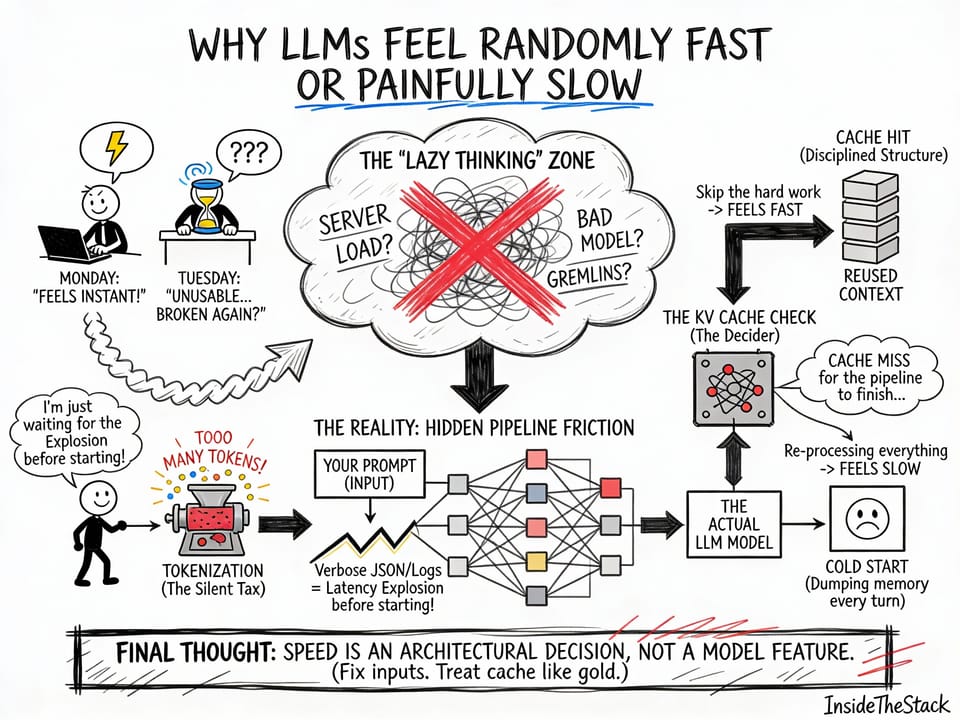
- Tokenization affects cost and latency
- Context design affects coherence and trust
- Model routing affects reliability and scale
- Feedback loops affect long-term quality
These are not isolated optimizations. They are one system.
Change one, and the rest shift.
This is why AI products feel fragile when poorly designed. Everything is coupled.
The biggest mistake teams make
They ask: "Which model should we use?"
Too early.
The better questions are:
- What decisions are we helping users make
- What information truly matters at each step
- What can be deterministic instead of probabilistic
- Where does AI add leverage, not novelty
Model choice comes last.
Practical guidance for builders
If you are building AI-first products, do this before shipping:
- Map user decisions, not user screens
- Design context like a scarce resource
- Separate reasoning from generation
- Route tasks intentionally
- Measure usefulness, not just accuracy
If you do this, model upgrades become easy. If you do not, every model change feels like surgery.
Final thought
AI architecture is not a backend concern. It is not a frontend concern.
It is a product concern.
The best AI systems feel simple not because they are simple, but because the complexity is handled where users never see it.
That is what building for AI actually means.
Read more on this and other topics on my blog site