AI Made Building Cheap. That Changed Everything.
AI compressed the cost of building. It did not compress the cost of knowing what to build. When a solo founder can replicate your MVP in three weeks, your code is not your moat. What actually survives: domain depth, distribution, and data loops.
Two years ago, shipping an MVP required a team of three to five engineers and four to six months of focused work. The cost was significant. The timeline was real. Engineering capacity was the primary constraint, and therefore the primary competitive advantage.
That world is gone.
Today, a single builder with Claude Code or Cursor can ship a working product in weeks. Sometimes days. AI inference costs dropped 92% in three years, from thirty dollars per million tokens to under two-fifty. Solo-founded startups surged from 23.7% to 36.3% over five years. CodeRabbit is advertising on physical billboards in Bangalore. Dev tools have gone mainstream enough to justify outdoor ad spend.
Building software is no longer the hard part.
That sentence changes everything about what it means to start a company.
The old moat is gone
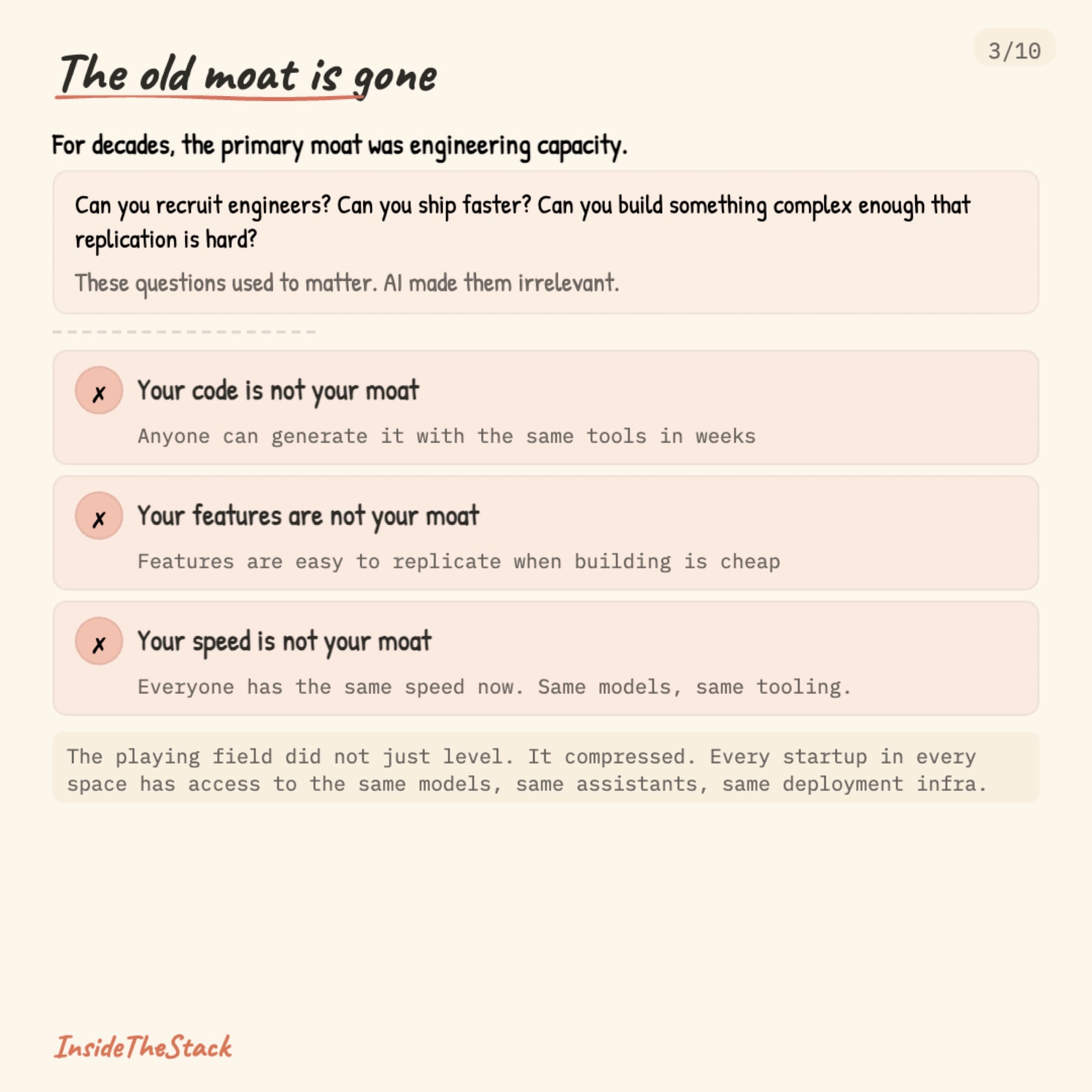
For decades, the primary moat for technology startups was engineering capacity.
Can you hire engineers? Can you ship faster than your competitor? Can you build something complex enough that replication is difficult? Can you maintain a velocity that makes your technical execution a barrier to entry?
AI collapsed that moat entirely.
If a solo founder with the same tools you use can replicate your MVP in three weeks, your code is not your moat. Your feature set is not your moat. Your tech stack is not your moat. Your speed of execution is not your moat, because your competitor has the same speed.
Every startup in every space now has access to the same models, the same coding assistants, the same deployment infrastructure, and roughly the same speed of shipping. The capability gap between a well-funded team and a solo builder has never been smaller.
The playing field did not just level. It compressed.
What AI did not compress
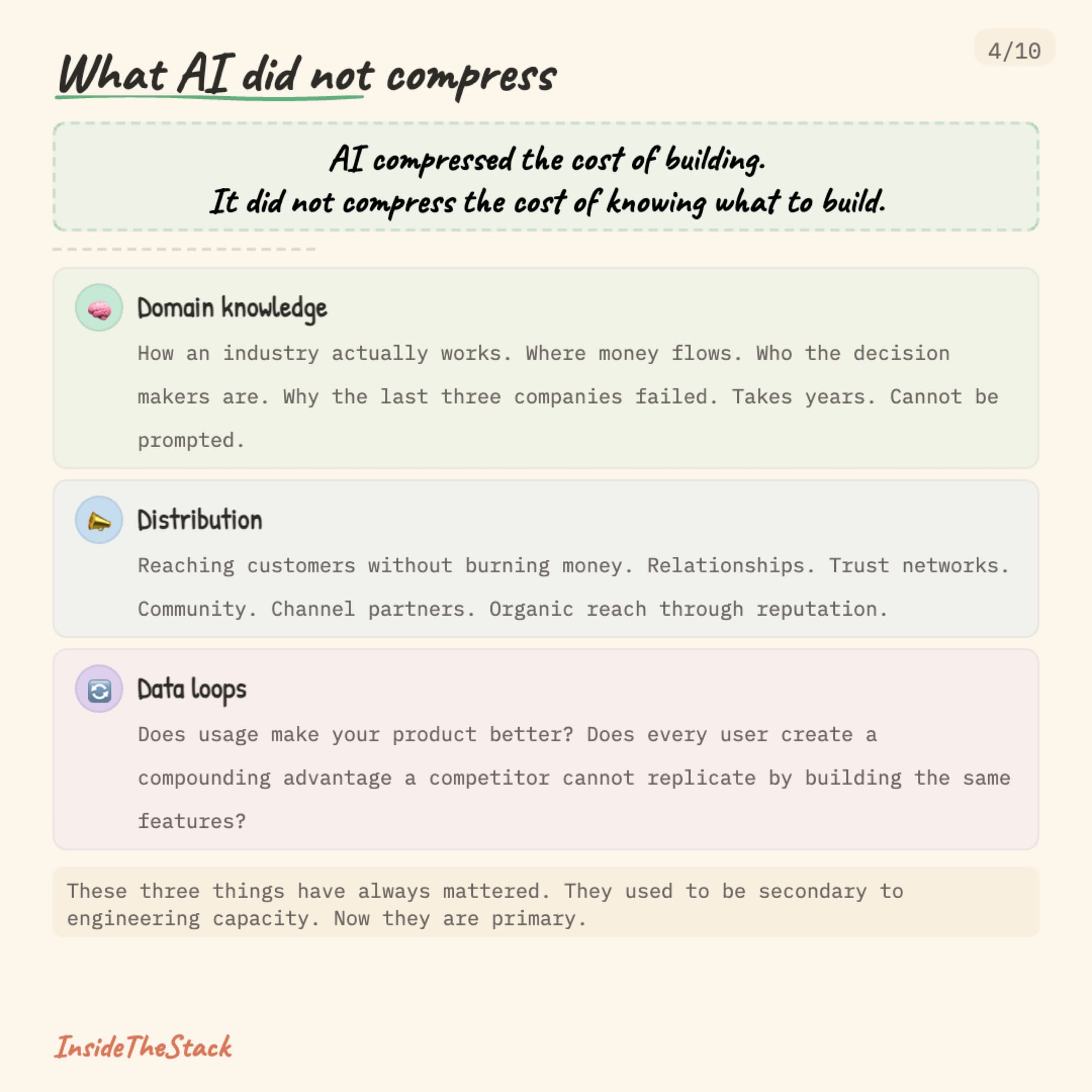
AI compressed the cost of building.
It did not compress the cost of knowing what to build.
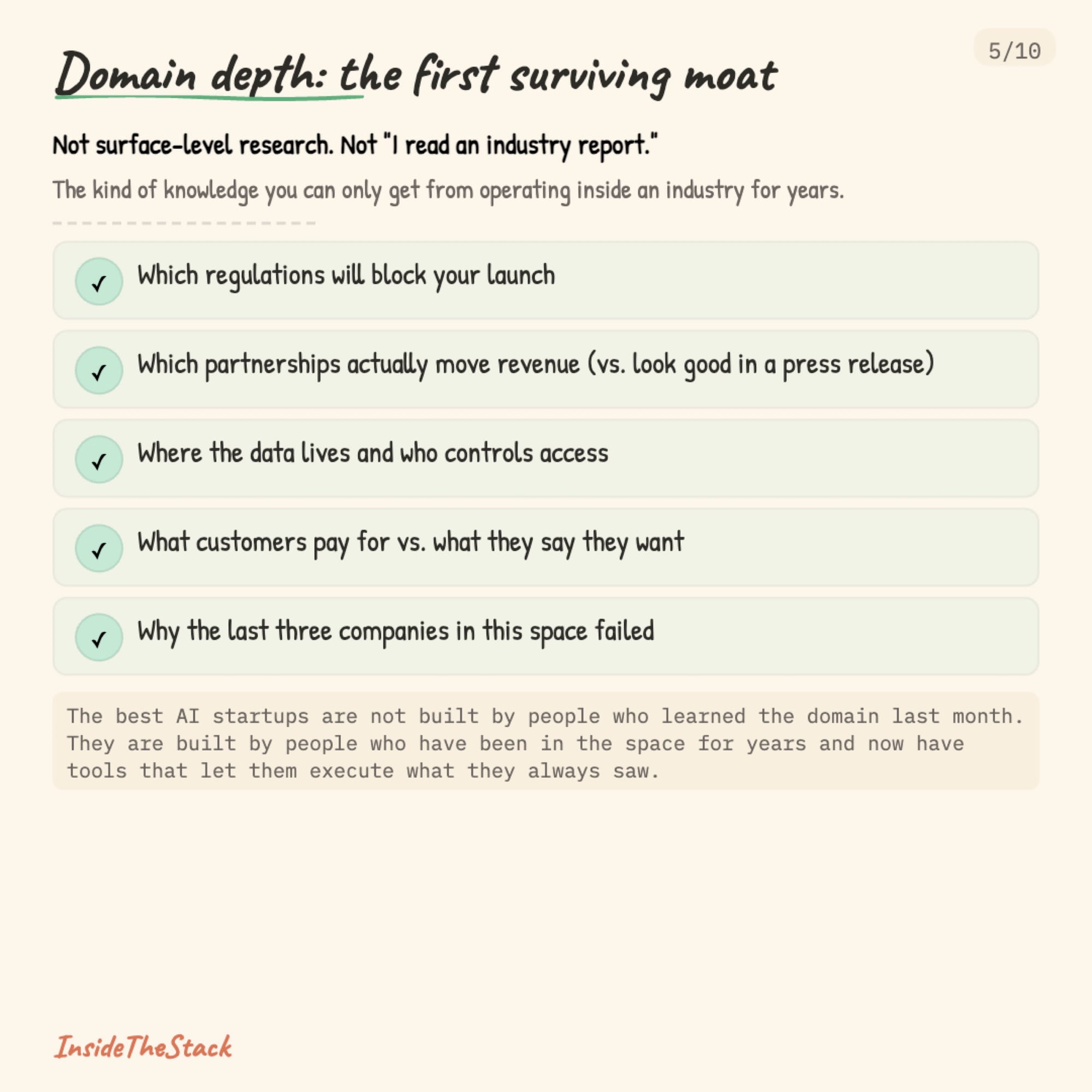
Domain knowledge cannot be prompted. Understanding how an industry actually works. Where the money flows. Who the real decision makers are. What the customer says they want versus what they actually pay for. Why the last three companies in this space failed. Which regulations will block your launch. Which partnerships actually move revenue versus which ones look good in a press release.
None of this comes from a language model. None of it can be researched in a weekend. It comes from years of operating inside a system, not observing it from outside.
Distribution cannot be downloaded. The ability to reach customers without burning money on acquisition costs. Relationships built over time. Trust networks. Community. Channel partnerships. Organic reach through reputation and presence.
Data advantages cannot be replicated on day one. The compounding loop where product usage generates data that makes the product better, which drives more usage, which generates more data. This is the only moat that grows stronger with time while building-based moats erode.
These three things have always mattered. The difference is that they used to be secondary to engineering capacity. Now they are primary. Building is table stakes. Everything else is the differentiator.
The three moats that survive
When building is cheap, three things still separate winners from everyone else.
The first is domain depth. Not the kind of knowledge you get from reading an industry report or prompting Claude for market research. The kind you get from operating inside an industry for years. Knowing which problems are real versus which ones sound real in a pitch deck. Knowing where the data actually lives and who controls access to it. Knowing the operational constraints that shape what customers will and will not adopt.
This kind of knowledge is slow to acquire and impossible to fake. It is the reason why the best AI startups are not being built by people who learned the domain last month. They are being built by people who have been in the space for years and now have access to tools that let them build what they always saw but could not execute alone.
The second is distribution. The ability to get your product in front of the right people without depending entirely on paid acquisition. The startups that win are almost never the ones with the best product. They are the ones whose product reaches the right people first.
Distribution is relationships. It is trust built over time. It is community presence. It is content that compounds. It is partnerships that open channels you cannot buy. When building is cheap and copying is fast, the company that reaches the market first and builds trust first has an advantage that better features alone cannot overcome.
The third is data loops. Once your product is live, does usage generate data that improves the experience? Does every new user create a compounding advantage that a new competitor cannot replicate simply by building the same features?
If your product delivers the same static experience to user one thousand as it did to user one, you are building a commodity. Someone will build the same thing faster and cheaper. If your product gets measurably better with every user, you are building something that compounds. That compounding is the moat.
The builder trap
There is a trap that most builders in the AI era fall into, and it is understandable because it feels productive.
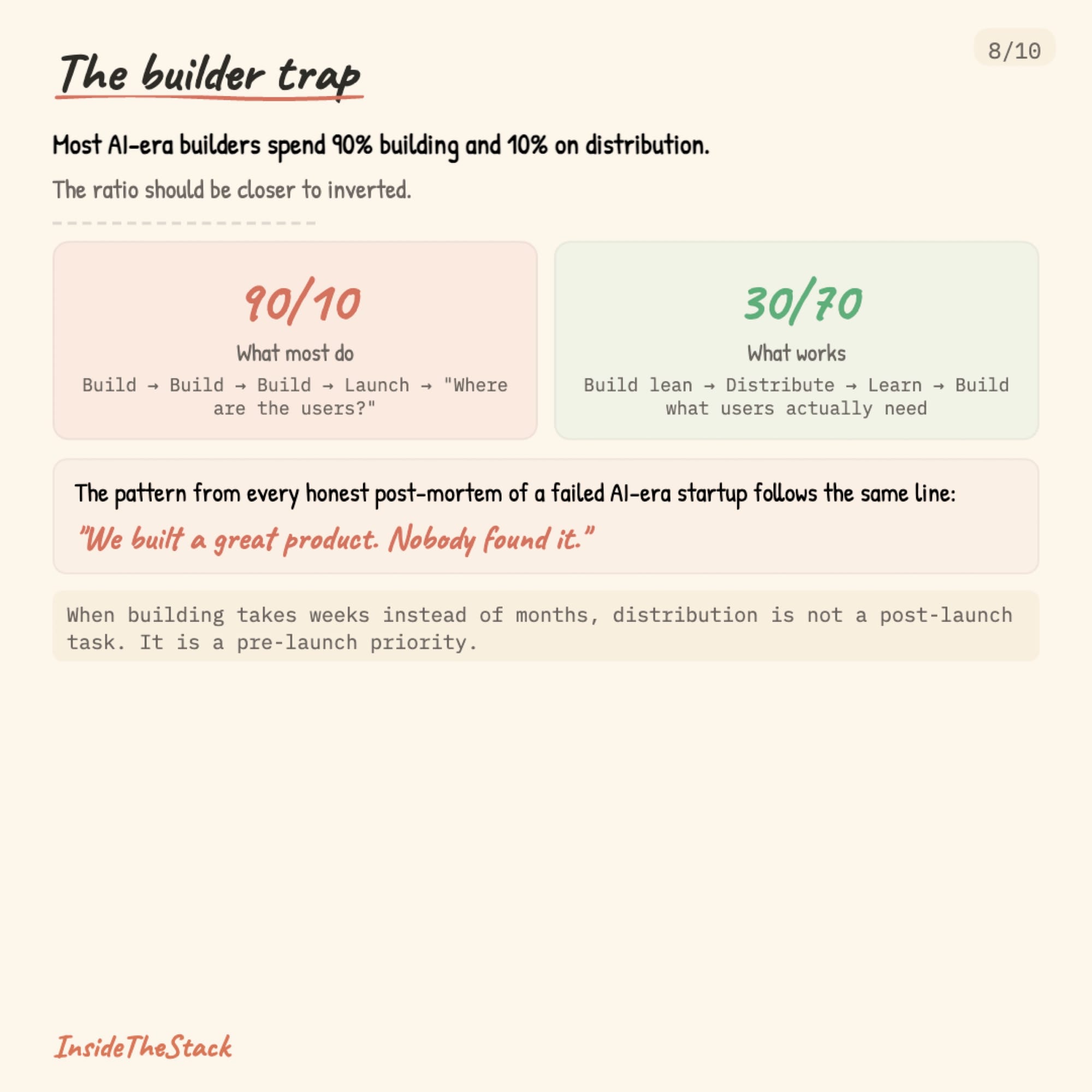
They spend ninety percent of their time building and ten percent on distribution. When building is exciting and distribution is uncomfortable, this allocation feels natural.
The ratio should be closer to inverted.
When building takes weeks instead of months, distribution is no longer something you do after launch. It is something you start before launch and prioritize during. The pattern from every honest post-mortem of a failed AI-era startup follows the same line: "We built a great product. Nobody found it."
Building is the easy part now. That sentence was not true three years ago. It is true today. And the builders who internalize it will allocate their time very differently from the ones who do not.
The India signal
Something is happening in India that is worth paying attention to.
Dev tool companies are spending money on physical billboards in Bangalore and other metros. Not digital ads. Billboard ads. That means the developer buyer base has grown large enough and mainstream enough to justify outdoor advertising spend. That is a market maturity signal.
Solo founders are shipping production products from cities across India. The cost structure of building here, combined with AI tooling that works identically everywhere in the world, has created an environment where Indian builders can compete globally with dramatically lower burn rates.
This is not a new phenomenon. India has always been a builder country. From the Tata conglomerate building industrial India from scratch to the current generation of founders shipping globally competitive products in healthcare, fintech, automotive, logistics, and SaaS.
What changed is not the ambition or the capability. What changed is that building is no longer the constraint. The tools are the same everywhere now. The cost of inference is the same everywhere. The speed of shipping is the same everywhere.
The things that are not the same everywhere are domain depth, distribution networks, local trust, and operating knowledge. These are areas where deep local knowledge is a structural advantage, not a limitation.
The markets where builders have both low cost structures and deep domain expertise are the markets that are structurally favored in the AI era. India is one of them.

What this means if you are building right now
Three questions worth asking yourself.
What do I know about this space that cannot be learned from a prompt? If the answer is nothing, your competitor can replicate both your product and your knowledge in a month. That is not a business. That is a feature demo with a landing page.
How will my first thousand users find me? If the answer is "we will figure it out after launch," you are already behind. Distribution strategy is not a post-launch problem anymore. It is a pre-launch priority.
Does my product get better with usage? If every new user generates data that improves the experience for the next user, you are building a compounding advantage. If not, you are in a race where the only variable is who ships first, and that race resets every time a new builder enters the space.
The real shift
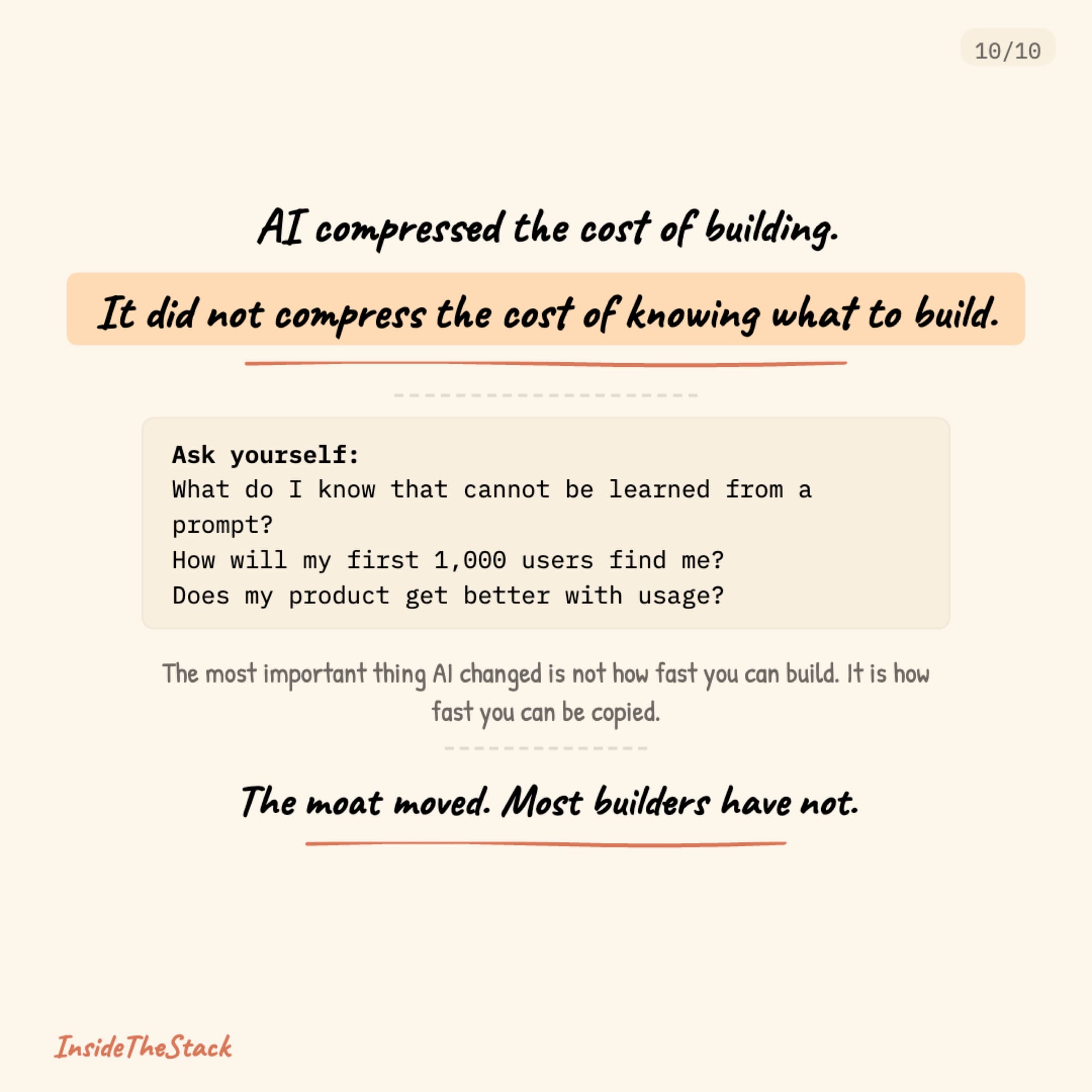
The most important thing AI changed about building startups is not how fast you can build.
It is how fast you can be copied.
When building is fast, everything that is not building becomes the differentiator. Domain expertise. Relationships. Distribution. Trust. Data. Brand. Community.
These are slow things. They compound over time. They cannot be prompted into existence. They cannot be shipped in a weekend sprint.
The builders who understand this will allocate their time accordingly. They will spend less time on features and more time on the things that features alone cannot create.
The ones who do not will ship great products that nobody uses.
AI compressed the cost of building.
It did not compress the cost of knowing what to build.
The moat moved. Most builders have not.
InsideTheStack: how real systems actually work.